

Water Bodies
Artistic Statement
AN ZAMO
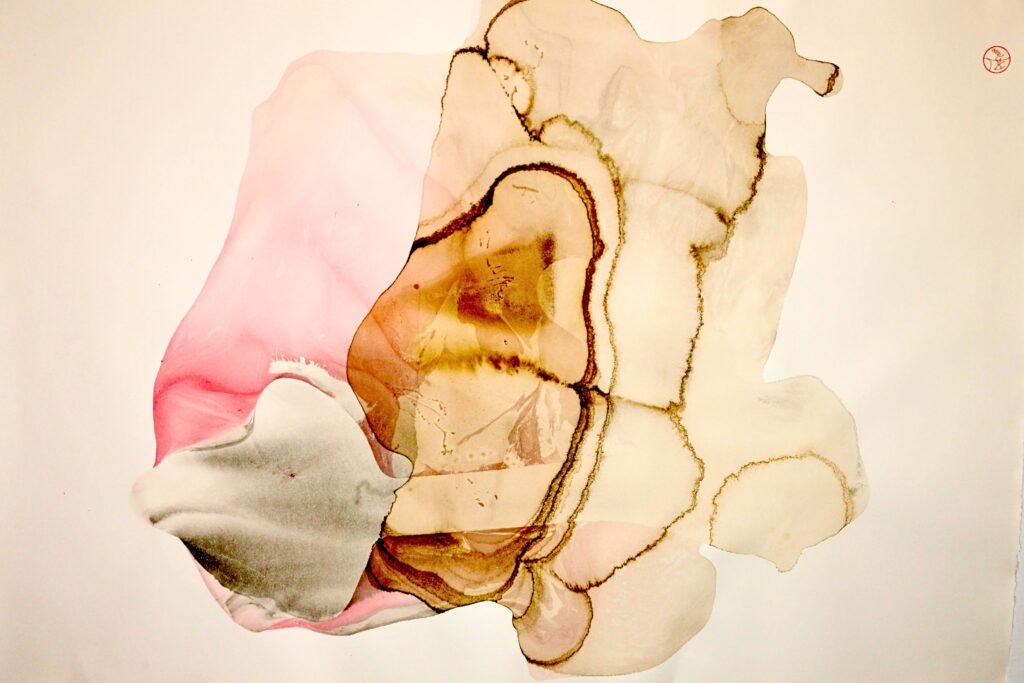
Memories of Water
This project speaks, at its core, of time. Of how something as unstable as water can, nevertheless, construct lasting images. Of how movement leaves a memory. In that constant flow, in that coming and going, forms emerge that at times seem to contain something recognizable: bodies of water where the image acquires a slight three-dimensionality, where the sediment evokes marine remains, scenes that never quite become fixed.
More subtly, a relationship with the territory also appears: with the land of childhood, southeastern Spain, a land where the arid, the mineral, and the sedimentary have a decisive weight.
Eroded surfaces, isolated pools where the water pauses briefly and leaves marks. An environment where water is not abundant, but whose appearance leaves a trace.
Through sustained—almost meditative—observation, the work anticipates and accompanies the behavior of water and its sedimentation processes. Water redistributes matter like a silent force: it displaces, transforms, and leaves traces. Sometimes, these traces seem to contain stories, objects that emerge, unexpected scenes that hint at themselves in stains, glazes, or accumulations: vestiges of something that has occurred.
The resulting forms arise from a continuous investigation with the materials themselves—water, pigment, matter, sediment—in a process that does not seek to impose an image, but rather to allow it to appear. In the sea, this dialogue becomes especially visible. The waves shape the surface and generate forms that emerge and dissolve almost simultaneously. Wet areas that slowly fade, lines that disappear, sediment that remains. Algae, sand, and minute fragments are constantly rearranged, composing ephemeral images that exist only for an instant.
The watercolor medium shares this logic. Water displaces the pigment, defines edges, and generates transparencies and irregularities. There is a relinquishment of control: what happens is never entirely predictable. Within this margin, randomness emerges, but also a kind of organic order, a construction that seems to generate itself. The project integrates a series of haikus as units of temporal condensation, where language and matter share the same logic of appearance and disappearance.